

We developed and presented a methodological framework to evaluate the performance of governance in the Fishery Improvement Projects. This practical framework aims to strengthen collaboration, decision-making, and community
leadership in Mexico and Latin America.
By the end of November, we presented a new framework to evaluate the performance of governance in the Fishery Improvement Projects, to strengthen collaboration, decision-making, and leadership among individuals promoting responsible fishery management.
It is a practical methodological framework for evaluating the performance of the space of participation or governance structures for fishery improvement projects, developed by our team and presented by Mariella Saenz Chavez, Coordinator of Governance, and Laura Ibarra García, Coordinator of Sustainable Fishing.
We presented this theoretical framework during a virtual seminar of the community of
practice of FIP, which reunited 38 participants from Mexico, Peru, Chile, and Nicaragua, as well as representatives of public and private sectors and donors like the Marine Stewardship Council (MSC) and Innovaciones Alumbra.
“It is really important, because as Pronatura Noroeste, we generated a framework that can be used in other countries and other FIP’s on a national scale”, emphasized Mariella Saenz, “there are people interested in promoting this evaluation in other places and to us it is really important to position this framework so it can be used in other contexts by other stakeholders.”
Governance is the heart of the initiative for sustainable fisheries.
We understand that sustainable fishing initiatives can only work if there is a very strong collaboration between the stakeholders involved, and if the communities assume leadership of their own processes. Therefore, the guide focuses on strengthening the broad governance framework.
“The processes of sustainable fishing initiatives involve a very strong collaboration, and it will work out if these efforts are carried out by the different stakeholders, where good communication, analysis, and understanding of the stakeholders' needs are encouraged, and with a genuine interest in managing fishery resources under a shared vision through a sustainable management framework. It is also important that the community assumes leadership of its own processes”, explained Mariella.
The practical guide represents a methodological framework that systematically evaluates the performance of the governance structure, and allows it to identify areas of opportunity that help define courses of action that contribute to the strengthening of the governance, and therefore, it has a more effective impact on the design and the application of the FIPs. She explained that this framework evaluates four components and 36 criteria related to:
● Participation and follow-up
● Planning and Operation Instruments
● Financing
● Realization
The methodology is based on a framework of self-perception and self-diagnosis that we had already developed to evaluate advisory boards of protected areas in Mexico, which have been systematically evaluated for more than 10 years, as well as on similar experiences implemented in Peru, which makes it possible to rely on robust criteria that are adaptable to different contexts.
From diagnosis to implementation
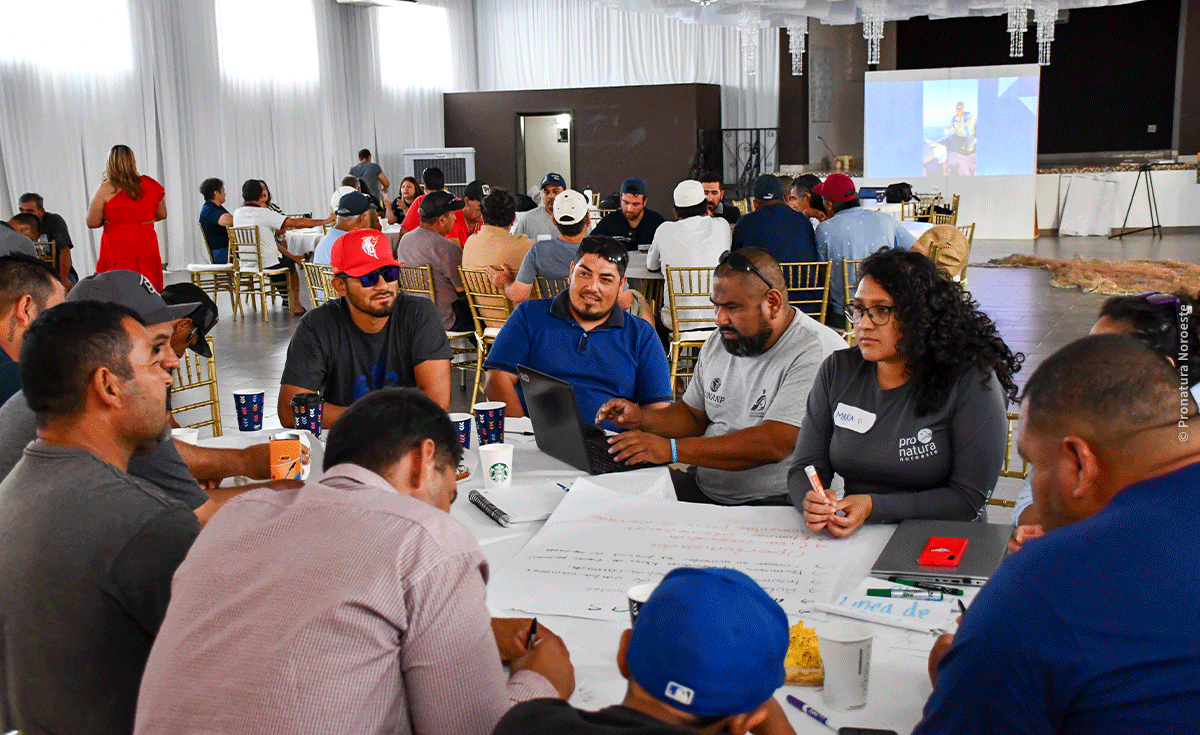
The implementation of the governance framework involves approximately three months of fieldwork and interviews with the individuals which forms the governance structure, or those who participated in its formation, followed by data analysis and the preparation of a technical report.
“As part of these technical reports, a filter covering the 36 criteria is presented, allowing for a rapid assessment of the status of the governance structure within a given FIP. The group of individuals that make up this structure can then discuss the results and decide which criteria to strengthen through specific actions in their own work plan,” she stated.
At this moment, we are implementing the evaluation of this framework within the governance structures of six FIPs, three in the Gulf of California and three on the Pacific Coast of the Baja California Peninsula.
“Based on the results from the filter system and the recommendations provided by the respondents themselves, individuals who participated in the FIP's concrete actions are being proposed to improve the performance of the governance structure, ensuring it adequately supports the implementation of the FIP through a collaboration-based work model,” she pointed out.
A call to strengthen sustainable fisheries through governance
For the PNO team, sharing this framework with the FIP Community of Practice in Latin America is an effort to scale the impact of these initiatives beyond our own territory,
especially across Latin America.
“Even though we look alike and share the same language, we each have unique
idiosyncrasies. Each one is special. Therefore, we aim to strengthen this framework,
implement criteria used in other FIPs, and make it adaptable enough to be applied in other countries. That is why the work within the FIP Community of Practice is so important”. Mariella Saenz sustained.
Our experience shows that strengthening governance becomes a fundamental pillar for FIPs to progress toward environmental sustainability, social responsibility, and economic growth. The effectiveness of these projects largely depends on their members, not only by participating but also by sharing a common vision that is well-articulated, and by which the individuals lead, promote, and execute the necessary processes with commitment, collaboration, responsibility, communication, and consensus-based decision-making.
We invite Organizations, fishing communities, public institutions, private sectors, and donors to learn about, implement, and add this framework into their processes. We believe that evaluating governance is the first step toward strengthening FIPs and ensuring their long-term impact and support, which directly contributes to promoting sustainable fisheries.

Translated by: Edgar Bolaños.
Reviewed and edited by: Belinda Carpio.