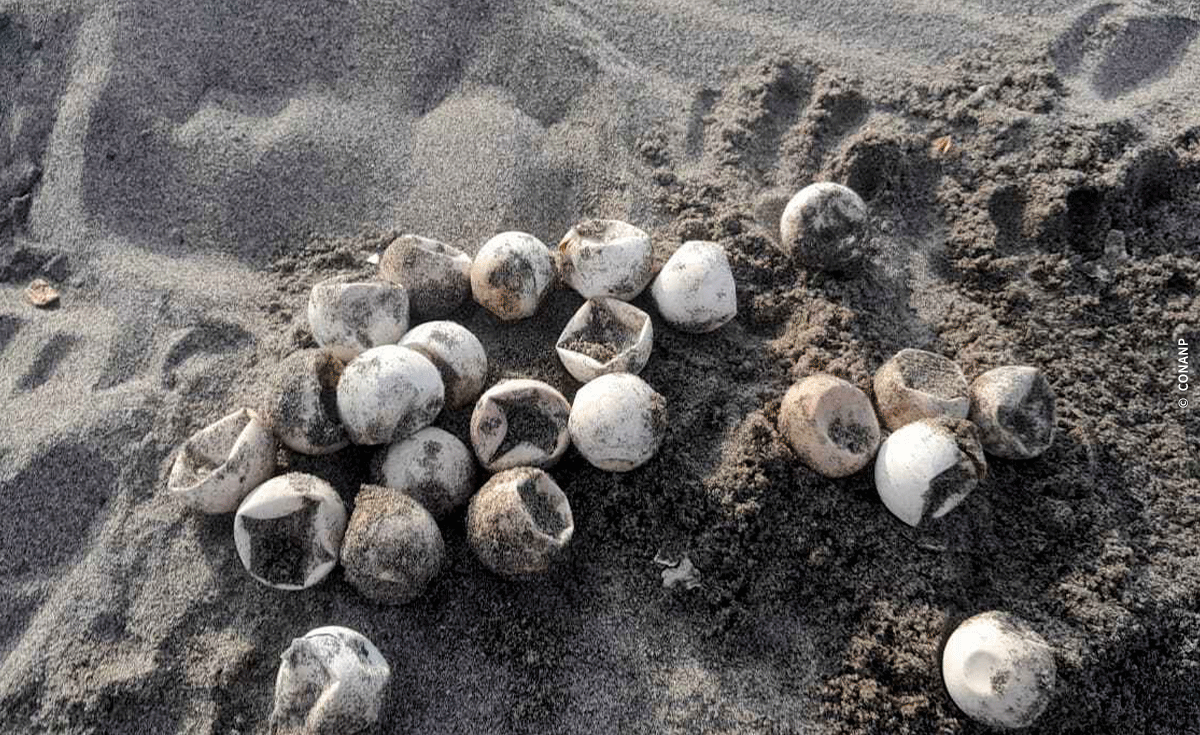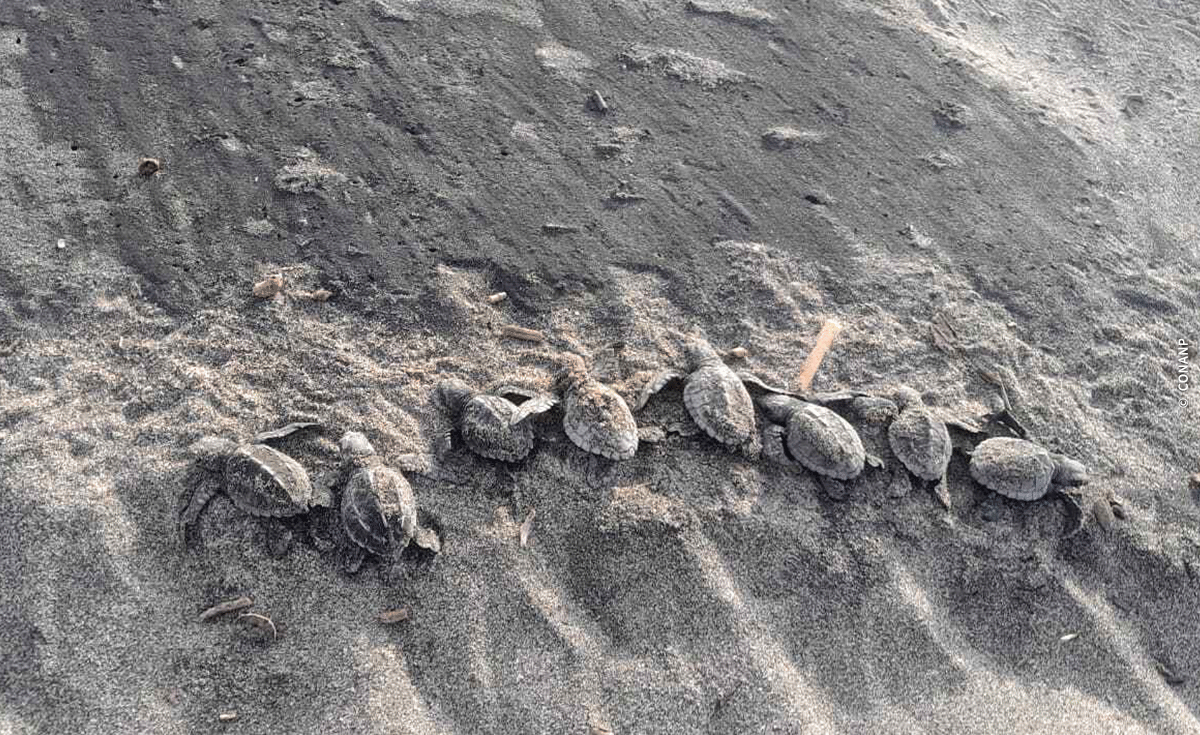


Eighty-four Olive Ridley hatchlings were born at Playa Ceuta, marking a successful start to the nesting season thanks to the conservation efforts of CONANP, Pronatura Noroeste, the Autonomous University of Sinaloa, and local communities in Sinaloa.
The olive ridley turtle (Lepidochelys olivacea) is a threatened species of great importance in Mexico. An event of positive impact has happened: eighty-four hatchlings were born naturally at Playa Ceuta, without the need for artificial incubation.
This event is significant, as it indicates that the 2025 nesting and hatching season has begun earlier than usual. Typically, the season occurs from June to December. This also demonstrates that our conservation efforts are paying off.
The National Commission of Natural Protected Areas (CONANP, by its initials in Spanish) reported that 84 hatchlings successfully emerged from over 120 eggs laid on the beach at one of the most important sanctuaries for this endangered species.
The biologist Juan Carlos Leyva Martínez, regional coordinator for Pronatura Noroeste in Sinaloa, Durango, Chihuahua, and southern Sonora, said: “This is great news, it tells us that the efforts made across the turtle sanctuary are positively affecting the entire coastline under CONANP management.”
Each year, nests face natural threats such as coyotes and raccoons, as well as human-related dangers including vehicle traffic on the beach, the presence of pets or exotic animals, and improper handling of the eggs.
The conservation of the olive ridley turtle at Playa Ceuta is the result of a joint effort among various communities and institutions. Having the National Commission of Natural Protected Areas as the leading management of the sanctuary, in collaboration with community groups from Rosendo Niebla, Celestino Gasca, Ceuta, and Ceuta Norte. In the latter area, efforts also come together from the Autonomous University of Sinaloa (UAS), the municipal government of Elota, and Pronatura Noroeste.
“This ongoing work includes the protection, conservation, and management of over 500 hectares of coastline, from El Patole to the mouth of Cospita (both communities in southern Sinaloa),” he noted.
Each group is responsible for different stretches of the coast, working to protect nests and release hatchlings. An effort that also supports research and monitoring to safeguard the turtles that arrive to complete their life cycle on the Sinaloa coast.
“No effort is isolated; every contribution adds up to the conservation of this iconic species of the Mexican Pacific,” said Leyva Martínez.
With the first nest already hatched, expectations are high for a successful season that reinforces Sinaloa’s commitment to biodiversity and the protection of its marine species.
DID YOU KNOW?
Playa Ceuta, in Sinaloa, is the oldest and most iconic turtle sanctuary in the state, and a pioneer in sea turtle conservation efforts in the region.
Each year, between June and December, olive ridley turtles, guided by their biological memory, return to Playa Ceuta to nest. They can lay up to three nests per season, each containing approximately 100 eggs, which hatch in about 40 days.
The sanctuary hosts up to 600 nests annually, and thanks to conservation efforts, nearly 80 percent of the eggs successfully become hatchlings that reach the sea.
Translated by: Airam Norzagaray
Reviewed and edited by: Hannah Peralta